The Water-Bottle Desk Reset That Fixed My “Collapsing Posture” Problem
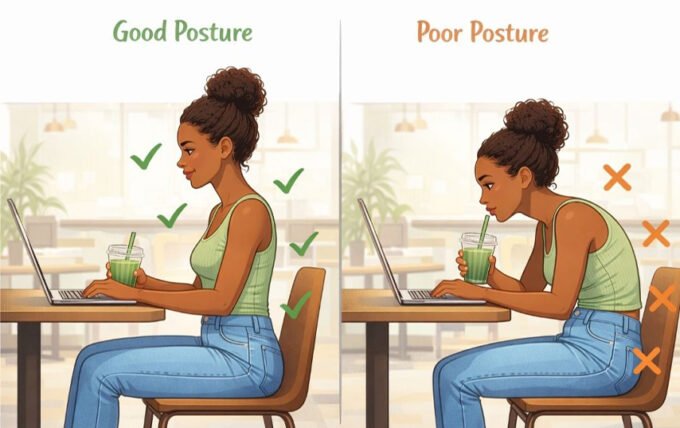
I didn’t notice my posture getting worse in a dramatic way. It wasn’t like I woke up one day shaped like a question mark. It was quieter than that. It was more like catching myself in a reflection and thinking, Why do I look like I’m apologizing to the air? Or standing up after sitting for a while and feeling that stiff, tight upper-back feeling that makes you roll your shoulders like you’re trying to restart your body. I blamed my chair, my desk, my phone—everything except the obvious thing: I sit too much, and I sit like a tired person who keeps forgetting they have a spine.
I didn’t call it a “fitness issue” at first. I called it “work.” But the pattern was too consistent to ignore. I’d start the day sitting normally, then without noticing I’d slide forward—shoulders rounding, head drifting forward, neck doing that thing where it feels like it’s holding up a bowling ball. I wouldn’t notice until it felt uncomfortable, and by then it always felt like I’d been sitting like that for hours.
The Slow Collapse That Kept Repeating
The worst part wasn’t one bad posture moment. It was how automatic it was. My shoulders creep up when I’m focused, not always because I’m stressed (maybe I am), but because my body turns concentration into tension. I’d notice my shoulders were basically trying to become earrings, drop them, then they’d climb right back up later. And every time I thought, I need a proper posture routine, I remembered the truth: the moment something becomes a “proper routine,” it becomes a project, and projects require energy. On low-energy days, projects die. I didn’t need a perfect routine. I needed a tiny reset that didn’t feel like a big decision.
The Moment I Realized the Fix Had to Be Small
This wasn’t a big breakthrough. It was me reaching for my water bottle, taking a sip, and realizing I hadn’t moved my upper body in hours except for typing. I remember thinking, My body is stuck. Not broken. Just stuck. And then it hit me: I reach for my water bottle multiple times a day. That reach was already happening. So instead of trying to remember a routine, I decided to use what was already there.
The Rule I Used
The rule was simple: every time I drink water, I do a short posture reset first. Not after—before. Because if I do it after, I forget. If it happens right before the sip, it sticks to the action. I also needed it to be short, because if it takes more than a few seconds, I won’t do it consistently. It needed to feel good, because if it feels forced or intense, I’ll avoid it. And it needed to be repeatable, because some days I’m focused, some days I’m tired, some days I’m distracted—this had to work across all of that.
What the Water-Bottle Reset Looks Like
I’m not going to pretend this is a perfect sequence. It’s not. It’s just a small set of actions I repeat because they’re simple enough to survive real life. Before I sip, I “unround” for a second—sit tall, not stiff, just uncollapsed, like I’m stacking ribs over hips instead of folding forward. Then I drop my shoulders away from my ears without forcing them back, just letting them fall down (sometimes I realize they were way higher than I thought, which is always slightly annoying). Then I do the gentle “chin back” moment, pulling my chin back just enough to feel my neck lengthen instead of leaning forward. After that I take one slow breath that opens the front of my body a little—nothing deep or dramatic, just one breath that expands the chest slightly and reverses that “front of me is shrinking” feeling you get from sitting all day. Then I drink water. That’s it. The reset stays tied to the sip, because the more I think about it, the weirder it becomes, so I keep it simple.
The Part That Almost Ruined It
Of course my brain tried to ruin it, because that’s what brains do when something works. After a few days, I thought, Maybe I should add more. Maybe I should do a full posture session. Maybe I should do it every hour. Then I remembered what happens when I add more: I quit. I also had the urge to turn it into a productivity thing—track water, track posture, track streaks—but streaks are dangerous for me. The moment I break one, my brain acts like the whole system is ruined. So I didn’t track anything. And when I forgot the reset sometimes (because I did), I didn’t turn it into a problem. I’d notice halfway through the sip, shrug, and do the reset on the next sip. That’s how habits survive—not by being perfect, but by being easy to return to.
What Changed Over Time
This wasn’t a transformation. It was more like a slow reduction in daily discomfort, which is honestly what I wanted. My neck felt less “worked,” like it wasn’t doing too much all day just to hold my head up in a bad position. My shoulders stopped living near my ears—not permanently, but I caught myself earlier, and catching it earlier kept tension from building into that heavy feeling. Sitting didn’t feel as stuck, which was the biggest change. I didn’t feel locked into one shape, because those small resets kept my body from fully collapsing even on long workdays. And standing up felt easier too—less creaky, less like my body was annoyed at me.
Conclusion
This water-bottle desk reset didn’t turn me into a posture-perfect person. It didn’t fix every stiff day, and it didn’t stop me from slouching forever. But it did something genuinely useful: it stopped my posture from collapsing silently for hours at a time. And once you prevent the collapse, you prevent a lot of the discomfort that shows up later. The best part is that it doesn’t require a special plan or a perfect routine—it just rides along with something I was already doing, and that’s why it actually stays.